
Our Approach

Environment
Richemont aims to manage environmental impacts across its operations and supply chains.

Social
Richemont fosters a collaborative working environment that supports professional growth.

Supply chain
Richemont undertakes due diligence and risk management on its supply chains.

Governance
Richemont anchors sustainability governance at the highest governance level of the Group.
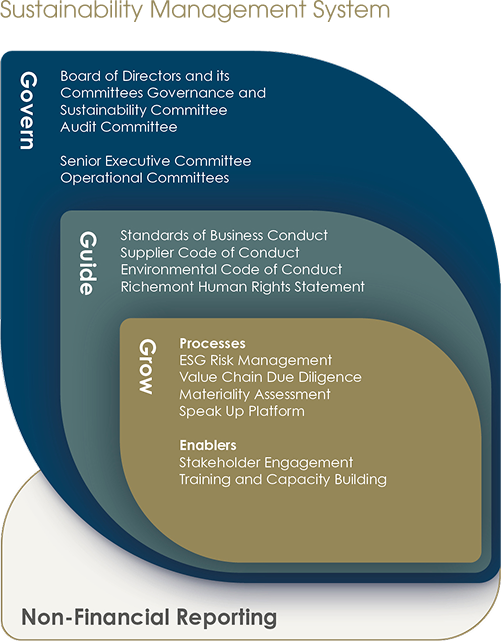
Sustainability Management System
The Group’s Standards of Business Conduct (the ‘Standards’) guide legal, ethical and sustainable decisions in countries where the Group operates. The Standards apply across the Group, encompassing its employees, directors, temporary staff, contractors, agents, consultants, and business partners. The Standards have been developed considering evolving regulations and they are reviewed regularly.
Building on the Standards of Business Conduct, Richemont’s Supplier Code of Conduct (SCoC), the Environmental Code of Conduct and the Human Rights Statement support the Sustainability Management System. The SCoC was updated in FY25, with an emphasis on environmental and social standards throughout the Group’s supply chains.
Richemont’s Sustainability Management System encompasses a risk management process that supports regulatory compliance and guides sustainability-related actions. Building on the ESG Risk and Opportunity Assessment process conducted in FY24, the ESG risk management process was further enhanced during FY25 and follows a series of defined steps.
Initially, a catalogue of ESG-related negative and positive impacts, along with financial risks and opportunities, is identified and compiled. In parallel, climate-related risks are categorised using the Task Force on Climate-related Financial Disclosures framework. This catalogue forms the basis for the Materiality Assessment. Subsequently, these identified impacts, risks and opportunities undergo prioritisation through a systematic calculation logic derived from interview scoring and a weighting mechanism.
The prioritised impacts, risks and opportunities are subsequently assessed to determine their effects, underlying drivers, existing mitigation efforts, and related action plans. The culmination of this process is the development of action plans designed to mitigate identified risks, with their progresses monitored and informed to the Group-wide Enterprise Risk Management (ERM).
Building internal knowledge and capacity on sustainability topics and standards supports the Group’s response to the evolving market and regulatory landscape.
Since the Richemont Sustainability Academy (the ‘Academy’) online platform was launched in FY24, it has offered a suite of courses and modules, as part of the Group-wide training programme. This programme provides upskilling resources to assist employees within the Group in acquiring relevant capabilities through targeted learning and development (L&D) opportunities.
Richemont’s Materiality Assessment underpins its non-financial reporting and informs the identification of material impacts, risks and opportunities. The Group has evolved towards a Materiality Assessment, whereby its positive and negative impacts on people and the environment, both actual and potential, and the effect of risks and opportunities on its financial position are assessed.
The Materiality Assessment is an evolving exercise over time. Richemont’s Materiality Assessment has built upon the results of previous assessments, including those undertaken in FY23 and FY25, which incorporated engagement with internal and external stakeholders. In FY26, the assessment was reviewed in consultation with relevant internal stakeholders, with a particular focus given to social topics across the regions.